TJALLING C.
KOOPMANS PRIZE |
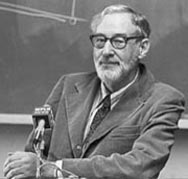 The Tjalling C. Koopmans Econometric Theory Prize is
named in honor of Tjalling C. Koopmans, the 1975 Nobel Laureate in economic science, whose
contributions to the development of econometrics are of fundamental and lasting importance
to the subject. The prize is awarded once every three years for the best article reporting
original research published in the Journal Econometric Theory over that
period. The selection of the winning article is made by the Advisory
Board of the Journal and the criteria for selection is based on Tjalling
Koopmans’ own research which is universally admired for its rigor, clarity and
originality. All articles published in Econometric Theory are candidates
for the prize except those that are authored or co-authored by the Editor and members of
the Advisory Board. The Tjalling C. Koopmans Econometric Theory Prize is
named in honor of Tjalling C. Koopmans, the 1975 Nobel Laureate in economic science, whose
contributions to the development of econometrics are of fundamental and lasting importance
to the subject. The prize is awarded once every three years for the best article reporting
original research published in the Journal Econometric Theory over that
period. The selection of the winning article is made by the Advisory
Board of the Journal and the criteria for selection is based on Tjalling
Koopmans’ own research which is universally admired for its rigor, clarity and
originality. All articles published in Econometric Theory are candidates
for the prize except those that are authored or co-authored by the Editor and members of
the Advisory Board.
The prize is accompanied by a financial award of $1,000. It is supported by the
publishers, Cambridge University Press, and Mrs. Truus Koopmans.
Cambridge University Press joins me in congratulating the authors on their success in
receiving this award.
2012–2014
The winning article and citation (written by the Advisory Board and Editor) are as follows:
Ivana Komunjer is awarded the Tjalling Koopmans Econometric Theory Prize for the paper
“Global Identification in Nonlinear Models with Moment Restrictions,” Econometric Theory, Vol. 28, No. 4, August 2012, pages 719-729.
Citation
The paper derives sufficient conditions for global identifiability in nonlinear model classes. The models are characterized by a finite number of unconditional moment restrictions. A set of assumptions is given which guarantee that the moment conditions uniquely determine the underlying true parameter. The main findings are based on a homeomorphism result. The assumptions given in the paper provide an alternative to the sufficient conditions for global identifiability of nonlinear systems given by F.M. Fisher (1966) and T.J. Rothenberg (1971). Earlier, conditions for identifiability in systems which are linear in the variables, but where the parameters satisfy nonlinear restrictions, had been obtained by L. Wegge (1965).
Cambridge University Press joins me in congratulating the author on her success in receiving this award.
Peter C. B. Phillips
April 2015
|
